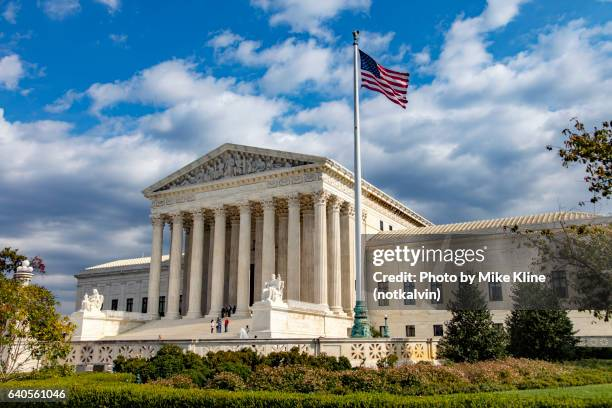
Court’s 6-3 ruling narrows scope of judicial orders but leaves citizenship question unresolved

By David Washington, The Orlando Voice Politics Editor
The Supreme Court delivered a significant victory to the Trump administration on Friday, ruling 6-3 to limit federal judges’ authority to issue nationwide injunctions against government policies. The decision came in response to lower court orders that had blocked President Trump’s executive order ending automatic birthright citizenship throughout the entire country.
What the Court Decided
The justices repudiated the concept of universal or nationwide injunctions, which prohibit the government from enforcing a law or policy anywhere in the country. However, the Court did not address whether Trump’s birthright citizenship order itself violates the Constitution.
Writing for the majority, Justice Amy Coney Barrett emphasized that federal courts should focus on resolving specific cases rather than exercising broad oversight of the Executive Branch. “When a court concludes that the Executive Branch has acted unlawfully, the answer is not for the court to exceed its power, too,” she wrote.
The Supreme Court Decision in Simple Terms
Think of it this way: When someone breaks a rule at school, the principal can stop that person from breaking the rule. But what if the principal tried to make a rule for all schools everywhere, not just their own school? The Supreme Court said that’s basically what some judges were doing – they were making decisions that affected the whole country, not just the people who came to their courtroom asking for help.
The Court said judges should focus on helping the specific people who ask them for help, rather than making decisions for everyone in America. It’s like a teacher helping one student with their homework versus telling every student in every school what to do.
The Birthright Citizenship Controversy
Trump issued the executive order ending birthright citizenship on Jan. 20, shortly after he was sworn into office for his second term. Beginning in 30 days, the order provided, babies born in the United States would not be automatically entitled to citizenship if their parents were in the U.S. either illegally or temporarily.
Multiple states and civil rights groups challenged the order, arguing it violates the 14th Amendment to the Constitution. The 14th Amendment provides that “[a]ll persons born or naturalized in the United States, and subject to the jurisdiction thereof, are citizens of the United States and of the State wherein they reside.”
This constitutional provision has deep historical roots. The 14th Amendment was added to the Constitution in 1868 to overrule one of the Supreme Court’s most infamous decisions, its 1857 ruling in Dred Scott v. Sandford. Later, in 1898, the Supreme Court solidified birthright citizenship protections in the Wong Kim Ark case.
14th Amendment Protections and “Birthright Citizens”
The Trump administration’s position challenges over 125 years of legal precedent regarding birthright citizenship. Critics of the executive order argue that the administration is attempting to circumvent constitutional protections by redefining who qualifies for citizenship under the 14th Amendment.
The terms “birthright citizens” or “mixed-status families” – often used to describe children born to undocumented immigrants – reflect a broader debate about whether birthright citizenship creates incentives for illegal immigration. The administration contends that the 14th Amendment’s phrase “subject to the jurisdiction thereof” excludes children of parents who are in the country illegally or temporarily.
However, legal scholars widely regard this interpretation as constitutionally dubious, noting that the Supreme Court has previously rejected similar arguments and that the 14th Amendment was specifically designed to ensure broad citizenship protections.
Immediate Impact and What Happens Next
The ruling allows Trump’s citizenship order to remain blocked for now, but narrows how broadly lower courts can issue such blocks. The court’s 6-3 ruling, authored by conservative Justice Amy Coney Barrett, did not let Trump’s birthright citizenship order go into effect immediately, directing lower courts that blocked it to reconsider the scope of their orders.
The three liberal justices dissented strongly. Justice Sonia Sotomayor read her dissent from the bench – a rare occurrence that signals deep disagreement. She stated that the majority had ruled that, “absent cumbersome class-action litigation, courts cannot completely enjoin even such plainly unlawful policies unless doing so is necessary to afford the formal parties complete relief.”
Justice Ketanji Brown Jackson filed a separate dissent, warning that “the majority’s decision to permit the Executive to violate the Constitution with respect to anyone who has not yet sued is an existential threat to the rule of law.”
Broader Implications for Federal Court Power
This decision represents a significant shift in how federal courts can respond to government policies they find unlawful. Historically, nationwide injunctions have been rare but have become more common in recent decades, particularly in immigration and civil rights cases.
The ruling could affect how future administrations implement controversial policies, potentially requiring challengers to file lawsuits in multiple jurisdictions rather than securing nationwide relief from a single court. This could make it more difficult and expensive to challenge federal policies, particularly for civil rights organizations and advocacy groups with limited resources.
The decision also reflects the ongoing tension between the judicial and executive branches over the scope of governmental power. While the Trump administration argued that nationwide injunctions undermine executive authority, critics contend that limiting such injunctions weakens important constitutional checks and balances.
Political and Legal Ramifications
For Central Florida’s diverse immigrant communities, the ruling creates continued uncertainty about citizenship rights. While the birthright citizenship order remains blocked for now, the narrowed scope of court authority could make future legal challenges more complex and time-consuming.
The decision arrives as immigration remains a central political issue, with implications extending beyond the current case. Future litigation challenging federal immigration policies may require different legal strategies and could face higher barriers to achieving broad relief.
Legal experts predict that this ruling will prompt renewed focus on class-action lawsuits and other mechanisms for achieving broad legal remedies. The decision may also influence how Congress considers legislation regarding both immigration policy and federal court jurisdiction.
As lower courts reconsider the scope of their injunctions in this case, the fundamental constitutional question about birthright citizenship remains unresolved, setting the stage for continued legal battles that could ultimately return to the Supreme Court for final resolution.
David Washington is The Orlando Voice Politics Editor and CEO of J & Washington LLC, a central Florida political consulting firm specializing in campaign management and public affairs. Join the T8020 Community and discover how tokenized civic engagement is reshaping political participation. Learn more about The Orlando Voice and the T8020 token at T8020Orlando.com.
The Orlando Voice will continue monitoring developments in this case and its impact on Central Florida’s communities.