By David Washington, The Orlando Voice Political Editor
1.0 The Mandate for Change: Expansion to an Eight-District Commission
The 2025 redistricting process in Orange County, Florida, represents a fundamental realignment of the county’s political landscape, driven by a direct voter mandate. The 2024 approval of a charter amendment expanding the Orange County Commission from six to eight districts was not an administrative adjustment but a strategic mandate to enhance accountability and representation for a rapidly growing populace of nearly 1.5 million. This decision necessitated a complete redrawing of the county’s political map.
The core objectives of this expansion established a complex mathematical and demographic challenge for the Mid-Decennial Redistricting Advisory Committee (MRAC), the 15-member panel tasked with developing the new maps. Key parameters included:
- Population Realignment: Each of the eight new districts was required to have a population between approximately 178,000 and 188,000 residents.
- District Restructuring: To achieve this balance, each of the six existing districts needed to shed between 60,000 and 70,000 residents—a significant reconfiguration that forced difficult trade-offs between mathematical equality and community cohesion.
To navigate this task, the MRAC undertook a comprehensive and publicly engaged process. Over the course of 19 meetings, the committee reviewed more than 28 proposed maps and considered over 330 public comments from residents. This intensive effort was governed by a strict legal and procedural framework designed to ensure a fair and defensible outcome.
2.0 The Rules of Engagement: Legal Framework and Guiding Principles
To ensure a fair, transparent, and legally defensible redistricting outcome, the MRAC’s work was anchored by a set of established legal and procedural guidelines. These criteria served as the benchmark against which all proposed maps were judged, forming the foundation for the committee’s deliberations and providing a framework to balance competing interests and technical requirements.
The MRAC was bound by three primary criteria, as outlined by the Orange County Assistant County Attorney:
- Equal Population Distribution: The foundational requirement that all districts be of roughly equal size to uphold the constitutional principle of “one person, one vote.”
- Compliance with Federal Anti-Discrimination Law: A mandate to ensure that new district boundaries meet all federal standards and do not dilute the voting power of minority communities.
- Adherence to Traditional Redistricting Principles: A set of established best practices that includes goals such as maintaining the compactness of districts, preserving existing municipal boundaries, and, most critically, protecting communities of interest.
The committee’s central challenge became clear early on: navigating the inevitable conflict between the rigid, mathematical requirement for “Equal Population Distribution” and the more nuanced, qualitative goal of preserving “communities of interest”—a tension that would define the entire debate. This difficulty was compounded by concerns raised by District 1 Commissioner Nicole Wilson, who argued that the foundational 2020 census data was outdated given Orange County’s rapid population growth, challenging the ability to draw maps that accurately reflect the county’s current demographic reality. The application of these guiding principles to various map proposals would ultimately define the central conflicts of the process.
3.0 Competing Visions: An Analysis of Key Map Proposals
The cartographic debate quickly became a proxy war over the nature of political power in Orange County, pitting a community-driven, grassroots proposal against a series of maps widely seen as engineered by and for the county’s political establishment. This conflict was most evident in the contrast between the WASHINGTON-2 map and its successor, WASHINGTON-2A, and the “Henry” maps, which drew support from established political figures.
3.1 The Community-Driven Proposal: The WASHINGTON-2 and 2A Maps
The WASHINGTON-2 map, authored by committee member David Washington, was explicitly framed as a proposal rooted in public feedback and established redistricting principles. Its foundational goals were a commitment to:
- Preserving communities of interest
- Ensuring legal and equitable representation
- Planning for responsible growth
- Reflecting stakeholder voices
The original map proposed a comprehensive realignment of the county, with each district designed to address specific, long-standing community concerns.
| District | Key Features and Strategic Rationale |
| District 1 | Keeps Horizon West whole and gives it a majority stake in its district for the first time; designed with transportation corridors in mind for compactness. |
| District 2 | Reunites historic municipalities of Ocoee and Winter Garden as requested by their mayors; includes unincorporated historic Black communities like Tildenville. |
| District 3 | The first of two majority Hispanic districts (52.99%); places the airport in a single district and reunites communities like Taft, South Chase, and Meadow Woods. |
| District 4 | The second and largest Hispanic district (56.5%); designed as a compact and geographically coherent district with clear boundaries. |
| District 5 | Corrects the “long-criticized shape” of the previous District 5 by creating a compact eastern region focused on rural communities like Christmas, Wedgefield, and Bithlo. |
| District 6 | Remains a majority Black district with a 50.53% Voting Age Population; retains the I-Drive corridor and Pine Hills’ traditional lines. |
| District 7 | One of two new districts, designed to be compact and traversable; keeps Maitland and Winter Park whole and united. |
| District 8 | The second new district, focused on urban communities in the north-central area; keeps Belle Isle, Edgewood, and Conway whole. |
Following extensive public comment, the proposal evolved into the WASHINGTON-2A amended map. This version was a direct response to community feedback, incorporating key changes aimed at strengthening community cohesion. Its most significant adjustments included unifying Pine Hills into a single district, uniting the communities of Clarcona and Lockhart, and, most critically, strengthening minority representation by adding a second majority-Black district while retaining two Hispanic-majority districts.
This community-focused approach garnered a broad coalition of support, receiving endorsements from the mayors of Winter Garden and Ocoee, Winter Park commissioners, and community groups across West Orange County. It also earned the backing of the Chamber of Commerce—a crucial endorsement that signaled the map’s viability not just with community activists but with the county’s business interests as well.
3.2 The Politically-Aligned Proposal: The “Henry” Maps
In contrast, the “Henry” maps were characterized by their association with individuals from within the political sphere. The authors were identified as Jason Henry, a former political consultant and current congressional staffer, and Roberta Johnson, a former candidate for office. Analysis of public comments indicated that support for these maps came largely from “known politicos, current elected officials, and political operatives,” positioning them as an alternative aligned with established political interests.
This divergence in approach and support set the stage for a series of contentious political maneuvers that came to define the latter stages of the committee’s work.
4.0 Political Dynamics and Process Controversies
Beyond the technical cartography, the redistricting process descended into a political battleground where allegations of unethical conduct and deliberate misinformation campaigns threatened to delegitimize the committee’s work and expose any final map to legal challenges.
A focal point of this conflict was Wes Hodge, Chief of Staff to Commissioner Kelly Martinez Simrad. This campaign to discredit public input was a clear tactical move designed to undermine the grassroots momentum of the WASHINGTON-2 map and create political cover for the committee to favor the insider-backed “Henry” proposals. Hodge’s actions drew sharp criticism:
- Unethical Conduct: Hodge publicly admitted to “spying over people’s shoulders at public meetings to read private conversations on their phones,” an admission that raised serious ethical concerns for a county employee.
- Discrediting Public Input: He made public comments implying that resident support for the WASHINGTON-2 map was “fake and manufactured,” a direct attack on the dozens of residents who testified in its favor.
- Alleged Hypocrisy: Critics noted that while Hodge attacked ordinary residents, he remained silent about the political backgrounds of the authors of the competing “Henry” maps, who were themselves political operatives.
The grassroots support for WASHINGTON-2 was defended as “real democracy in action,” with advocates pointing to the organic organizing efforts of groups like the Tildenville Community Alliance, Pine Hills Community Council, and the People of Clarcona–Ocoee Community Association as proof of genuine citizen engagement. The dynamic was further inflamed by a controversy involving Erika Jackson, who allegedly made a false claim to speak on behalf of the Tildenville community. This incident was framed as evidence of a “condescending mindset” that dismissed the community’s capacity to form its own views, with Hodge further dismissing Tildenville residents’ testimony as them having been “put up to it.”
These maneuvers introduced potential legal jeopardy into the process. District 1 delegate Bobby Olszewski publicly “warned against drawing maps for specific candidates,” an act that unilaterally introduced the appearance of political intent and, critics argued, could open any approved map to legal challenges. These procedural and ethical disputes formed the contentious backdrop for the committee’s final, most critical task: selecting the two maps that would be forwarded to the County Commission for a final decision.
5.0 The Final Recommendation: Map 1A vs. Map 7B
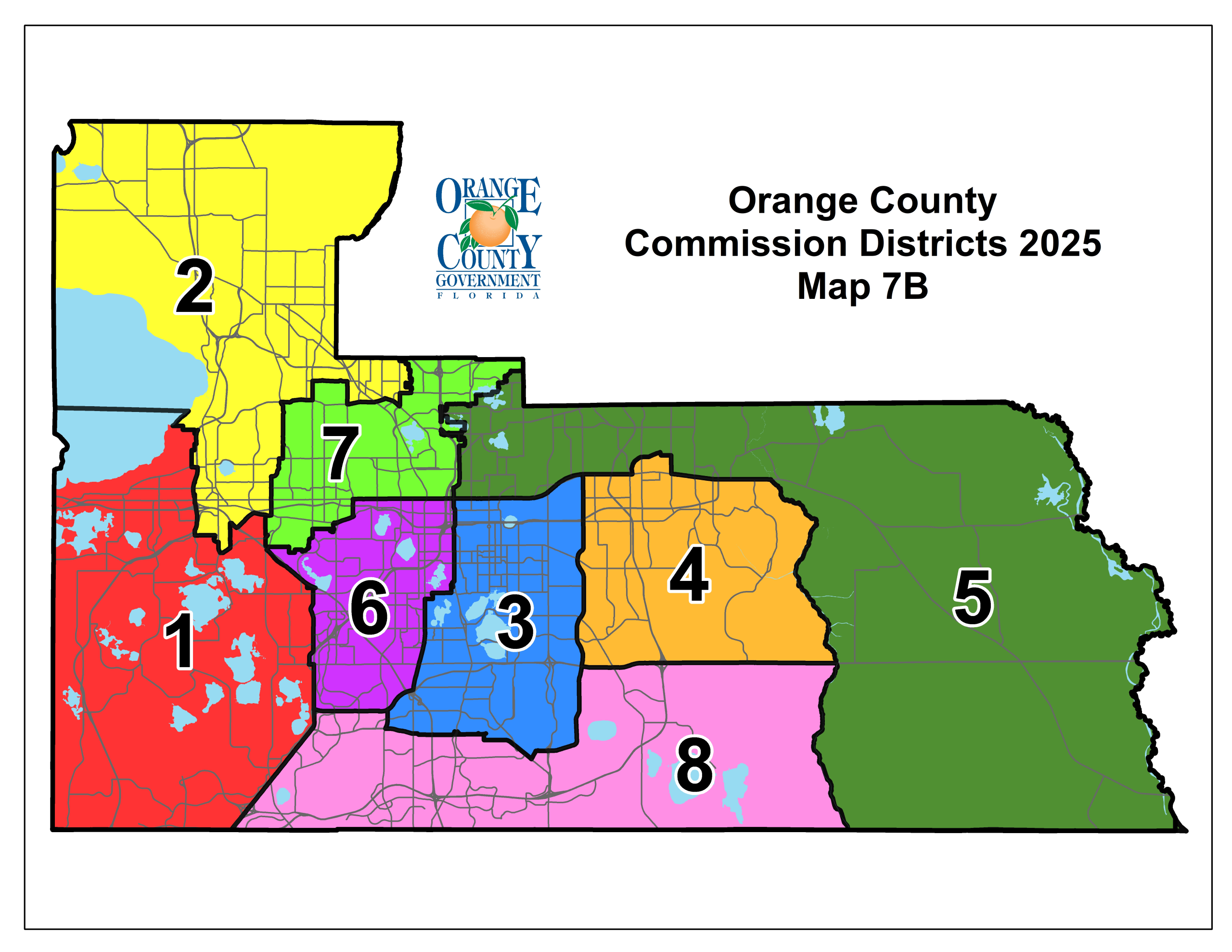
After extensive debate and consideration of public comment, the MRAC advanced two final maps—Map 1A and Map 7B—to the Board of County Commissioners. This decision set the stage for a final vote with significant consequences for the political voice and influence of key communities within the county.
The fundamental conflict between Map 1A and Map 7B centered on their differing treatments of Pine Hills and Winter Park, two communities with distinct demographic and economic profiles.
- Map 1A proposed grouping Pine Hills, Winter Park, Maitland, and Eatonville together. This configuration raised immediate concerns from Pine Hills advocates, who argued that aligning their predominantly minority community with wealthier, suburban areas would dilute their collective voice and policy influence.
- Map 7B, in contrast, proposed a different alignment. It kept Pine Hills united with the communities of Eatonville and Orlovista, while placing Winter Park in a separate district with much of East Orange County. This approach was seen as reflecting different coalition priorities and preserving the distinct character of each area.
This debate highlighted a broader theme that permeated the entire process: the tension between preserving “communities of interest” and the strict adherence to mathematical population equality. Advocacy groups from minority communities expressed fears that historic representation gains were at risk of being undone if their neighborhoods were split or absorbed into larger, dissimilar districts. Committee member James Auffant voiced these concerns directly, stating that some proposed maps appeared to be penalizing District 6 and disadvantaging the county’s Hispanic and African American populations. The final choice between these two maps will therefore have a lasting impact on the county’s governance and representational fairness.
6.0 Conclusion: Future Implications for Governance and Representation
The selection of a final map by the Board of County Commissioners at its upcoming October public hearing will mark the culmination of this historic redistricting process and set the political terrain for the next decade. The decision carries profound implications for governance, representation, and community power across Orange County.
Stakeholders should be prepared for several key forward-looking impacts that will take effect for the 2026 election cycle:
- Impact on Minority Voting Power: The new district boundaries, particularly the final alignment of neighborhoods like Pine Hills, will reshape minority voting blocs. New coalition dynamics will emerge, potentially influencing which candidates are viable and which policy issues receive priority from the expanded eight-member commission.
- Shifts in Neighborhood Alignment: Municipalities like Winter Park, historically aligned with East Orange County’s rural interests, may be absorbed into urban-centric districts, forcing a fundamental shift in their policy priorities and their relationship with county government.
- New Political Realities: The creation of two new commission seats and the reconfiguration of existing ones will trigger a political scramble, creating open-seat opportunities and forcing incumbent-on-incumbent decisions. Stakeholders must anticipate a more competitive and potentially volatile 2026 election cycle as new candidates emerge and old alliances are tested.
While the expansion to eight districts is a positive step for accountability, the specific boundaries of those districts will determine whose voice is amplified and whose voice may be diminished. Continued and vigilant public engagement will be essential to ensuring that the new system delivers on its promise of fair and equitable representation for all Orange County residents.
CEO David Washington was appointed by the Orange County (FL) Board of County Commissioners to serve on the 2025 Mid-Decennial Redistricting Advisory Committee (MRAC) as an Advisory Committee Member, representing District 4 on behalf of Commissioner Maribel Gomez Cordero. David is also the Founder/Owner of J & Washington LLC, Political Consultants, Florida.